







Introduction
Tool wear in CNC machine is one of the most common and critical issues in modern manufacturing. At Millwright CNC, students are trained to understand machining challenges like tool wear, surface finish problems, and productivity losses.
Tool wear affects machining accuracy, cycle time, and production cost. Every machinist, CNC operator, and CAM programmer trained at Millwright CNC must understand CNC machining tool wear to improve productivity and extend CNC tool life.
In this article, we explain tool wear in CNC machine, its types of tool wear, causes of tool wear, and practical tool wear prevention methods used in real shopfloor environments taught at Millwright CNC.
What is Tool Wear in CNC Machining?
Tool wear in CNC machine refers to the gradual loss of material from the cutting tool during machining due to friction, heat, pressure, and chemical reactions between the tool and workpiece material.
At Millwright CNC, trainees learn to visually identify tool wear and adjust machining parameters accordingly. As CNC machining tool wear increases, the cutting edge becomes dull, leading to poor surface finish, dimensional errors, and reduced CNC tool life.
Types of Tool Wear in CNC Machines
1) Flank Wear
- Most common type of tool wear in machining
- Occurs due to rubbing between tool and workpiece
- Directly reduces CNC tool life
- Practically demonstrated at Millwright CNC during hands-on training
2) Crater Wear
- Occurs on the rake face of the tool
- Caused by high temperature during cutting
- Frequently seen while machining steels and alloys in Millwright CNC lab
3) Notch Wear
- Occurs near depth-of-cut line
- Common in hard materials like stainless steel and titanium
- Covered in advanced modules at Millwright CNC
4) Built-Up Edge (BUE)
- Workpiece material sticks to cutting edge
- Changes tool geometry
- Leads to rough surface finish and faster tool wear in CNC machine
- Explained with real examples at Millwright CNC
Major Causes of Tool Wear in CNC Machines
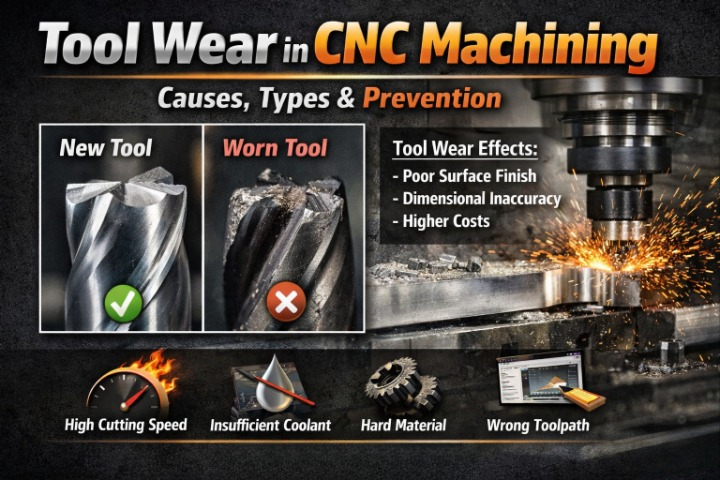
The main causes of tool wear include:
- Excessively high cutting speed
- Too high feed rate
- Insufficient coolant or lubrication
- Wrong tool material selection
- Very hard workpiece material
- Incorrect tool geometry
- Poor CAM toolpath strategy
At Millwright CNC, students learn how wrong parameters accelerate CNC machining tool wear and reduce CNC tool life.
Effects of Tool Wear on Machining
If tool wear in CNC machine is not controlled, it results in:
- Poor surface finish
- Dimensional inaccuracy
- Increased cutting forces
- Machine vibration and chatter
- Frequent tool replacement
- Higher machining cost
This is why Millwright CNC emphasizes tool monitoring and parameter optimization in real machining jobs.
How to Reduce Tool Wear in CNC Machining (Tool Wear Prevention)
For effective tool wear prevention, follow these best practices taught at Millwright CNC:
- Choose correct tool material (HSS, Carbide, or coated tools).
- Optimize cutting parameters (speed, feed, depth of cut).
- Use proper coolant or MQL.
- Use optimized toolpaths in Mastercam or Esprit CAM.
- Monitor tool condition regularly.
- Avoid aggressive cutting conditions.
These steps significantly improve CNC tool life and reduce CNC machining tool wear, as practiced in Millwright CNC training programs.
Conclusion
Although tool wear in CNC machine is unavoidable, it can be controlled through proper tool selection, optimized machining parameters, and intelligent CAM programming. At Millwright CNC, students gain practical knowledge to minimize tool wear, improve surface finish, and increase productivity in real manufacturing environments. By focusing on tool wear prevention, manufacturers can reduce scrap, extend CNC tool life, and achieve consistent quality.