






Introduction
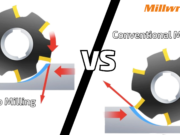
In modern manufacturing, choosing the right machining method directly affects productivity, surface finish, and tool life. Two widely used approaches are High Speed Machining (HSM) and Conventional Machining.
At Millwright CNC, students learn both machining techniques through real shopfloor practice, helping them understand where each method is best applied. This article explains the difference between high speed machining and conventional machining, their advantages, limitations, and industrial applications.
What is Conventional Machining?
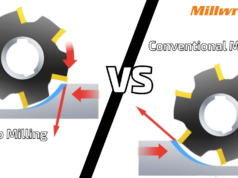
Conventional machining is the traditional machining process where cutting is performed at moderate spindle speeds and feed rates. Material removal relies more on cutting force rather than speed.
Key Features of Conventional Machining
- Lower spindle speed
- Higher cutting forces
- More heat transfer to tool and workpiece
- Suitable for basic CNC operations
Conventional machining is still widely taught at Millwright CNC to build strong fundamentals in CNC milling and turning.
What is High Speed Machining (HSM)?
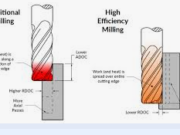
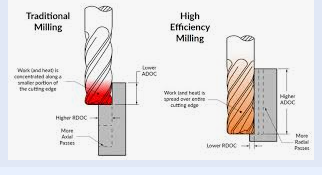
High Speed Machining (HSM) is an advanced CNC machining process that uses very high spindle speeds, optimized feed rates, and shallow depth of cut to remove material efficiently.
At Millwright CNC, HSM concepts are demonstrated using Mastercam high-speed toolpaths, showing how modern CAM software improves productivity.
Key Features of High Speed Machining
- Very high spindle speed
- Lower cutting forces
- Reduced heat at cutting zone
- Better surface finish
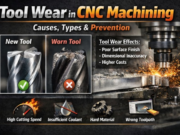
- Longer CNC tool life
High Speed Machining vs Conventional Machining – Comparison Table
| Feature | Conventional Machining | High Speed Machining |
| Spindle Speed | Low to Medium | Very High |
| Feed Rate | Moderate | High (optimized) |
| Cutting Force | High | Low |
| Heat Generation | High | Lower |
| Surface Finish | Average | Excellent |
| Tool Life | Shorter | Longer |
| Cycle Time | High | Reduced |
| CAM Requirement | Basic | Advanced (Mastercam HSM) |
Advantages of High Speed Machining
High speed machining offers several benefits in modern CNC shops:
- Reduced cycle time
- Excellent surface finish
- Lower cutting forces
- Improved CNC tool life
- Ideal for complex geometries
- Better accuracy for precision components
These advantages are practically demonstrated during advanced CNC training at Millwright CNC.
Advantages of Conventional Machining
Despite advanced methods, conventional machining still has its place:
- Simple programming
- Suitable for low-speed machines
- Lower machine cost
- Ideal for beginners learning CNC basics
- Easy parameter control
This is why Millwright CNC starts training with conventional machining before introducing HSM strategies.
Limitations of High Speed Machining
- Requires high-speed spindle machines
- Advanced CAM software knowledge needed
- Machine rigidity is critical
- Higher initial investment
At Millwright CNC, students are trained to select correct machining strategies based on machine capability.
Applications of High Speed Machining
High speed machining is widely used in:
- Aerospace components
- Die and mold manufacturing
- Medical parts
- Precision automotive components
- Complex 3D machining
Applications of Conventional Machining
Conventional machining is suitable for:
- General CNC turning and milling
- Heavy roughing operations
- Small job shops
- Basic CNC training
Which Machining Method is Better?
There is no single best method.
- Use Conventional Machining for basic operations, heavy cuts, and beginner-level CNC work.
- Use High Speed Machining for precision parts, complex toolpaths, and reduced cycle time.
At Millwright CNC, students learn when to use HSM and when to use conventional machining, making them industry-ready CNC professionals.
Conclusion
The difference between high speed machining vs conventional machining lies in cutting strategy, speed, and efficiency. While conventional machining builds strong fundamentals, high speed machining represents the future of CNC manufacturing. With hands-on exposure to both techniques, Millwright CNC prepares students for real-world CNC machining challenges using modern tools, machines, and CAM software.